
Classic car
Matching numbers guide
In the collector’s car hobby, most investment-minded buyers are acutely interested in a specific car’s history. One of the main aspects of that history is an original, or, as most people state it, numbers-matching, drivetrain. At Pedaltothemetal muscle cars we feature a plethora of original and numbers-matching classics, including ‘Cudas, Road Runners, Chevelles, Camaros, Corvettes and Trans Ams. And, if a potential buyer knows how to properly identify and interpret certain manufacturing codes, they can further validate their car’s history, or on request, we can provide it. Numbers-matching refers to the car’s unique VIN being stamped on major drivetrain components, and with some brands, Vin codes are stamped on hidden places on the body of the car, thus verifying those components’ “authenticity” in relation to the car. That said, there are a few different variations of that definition. Some people believe the car only needs an original engine to qualify as numbers-matching. Others believe the engine, transmission, and body codes must all be stamped for the car to qualify as numbers-matching. But the generally accepted rule is a car that has both its engine and transmission are stamped, although we feel that body numbers are maybe even more important. A car can be “matching numbers” with, for instance, a factory-installed replacement engine, as in some cases the engine or transmission was swapped at the factory due to engine problems. Body vin really identifies a car. Especially when it matches a car’s body tags or a build sheet or window stickers.
It wasn’t common for components of classic American cars to be VIN-stamped until the 1968 model year. That means most 30s, 40s and 50s era cars are considered original if they have an era-correct drivetrain. But as from early 1968 it became mandatory by law that all cars had vin stamping on body and drivetrains. From the factory, before that period, each piece of that drivetrain is equipped with a casting and/or date code. If that casting and/or date code is correct to the time period in which the car was assembled, it is assumed to have an original drivetrain. So for instance an early build 1968 Mopar can be called factory correct without having its matching number drivetrain in place, but a 69 car normally should have all numbers matching, or factory replacement and so on.
So beginning in 1968, virtually all American cars featured major components that were VIN-stamped to prevent theft and fraud. With that in mind, it’s pretty easy to fake a simple stamp, and, believe it or not, some clubs actually condone re-stamping components to create a correct appearance. This scenario is where a little of personal knowledge comes in. If the partial VIN stamp looks too clean, aligned, or planned, it could be a re-stamp, although through our many years of seeing hundreds of cars and vins, it’s hard to really guarantee these stamps. Even on the factory floors, errors were made, stamps were “incorrectly” stamped,” different types and sizes of fonts were used, and stamps were sometimes also re-stamped on top of each other, and so on. So there is no absolute guarantee that the numbers match. Discussions on these matters, especially online, are huge, and everybody has a different opinion about them. But be realistic and understand that the stamping was done by humans in a period of time when computer systems didn’t exist and changes occurred because of changes in work shifts, workers, tools, and administrations. We have seen cars that were produced almost right after each other on the production line, but one had many differences from the other. Also, keep in mind that most car brands have different production plants for the same cars!
We at PTTM do our best to describe our cars as good as possible, but even with our knowledge, it’s by no means a guarantee of exact science that a car is a 100% factory-correct number-match car. As that is no longer a sure deal after 45 years, But if we have a certain feeling, at a certain point in time, or facts that tell us that a certain car is not original matching, we will either not state the fact, state its date correctly, or state none of both. But again, in the end, the official rule we also follow is that if the numbers we read of a block or car at the correct location that is generally accepted match the vin, we can call it numbers matching. After that, it is up to the buyer’s feeling and risk to make sure for himself if the car is or is not that.
And to add some more details to the confusion, unfortunately, as with most historic things, classic car provenance isn’t an exact science. That means there are a few exceptions to the rule. For example, Chrysler’s 426 Hemis were cast in batches, with some blocks seeing quite a bit of shelf time before installation. And the 6.6-liter V8s for Pontiac’s ‘79 Trans Ams were assembled from stockpiled blocks cast in 1978. And also, for instance, Ford used some left-over 390 blocks and put them in 428 cars at a time when 428 short blocks were out of stock, and we can keep going on and on. Of course, if you’re still uncertain, you can always have the numbers validated by a professional inspector like Jerry MacNeish, Galen Govier, or Marti Auto Works, but again, even they can give an indication, but nobody can rule out that they might be really incorrect or correct in the end. There is, however, the general rule of thumb that it has to be realistic, and if you see a 1969 charger that has the Vin stamped on the block but not on the correct pad, but let’s say on the valve cover, you can assume that that car is not a true number-matching car.
In the classic car world, few phrases carry as much weight as matching numbers.
For some buyers, it is one of the first things they ask. For others, it is a phrase they have heard many times, but never fully understood. And to make things more complicated, not everybody uses the term in exactly the same way.
At PTTM Cars, we deal with many original, rare and highly collectible American classics. Think Plymouth ’Cudas, Road Runners, Chevrolet Chevelles, Camaros, Corvettes, Pontiac Trans Ams, Mustangs and other serious muscle cars. With cars like these, originality matters. History matters. Documentation matters.
But matching numbers is not magic. It is not a guarantee that every nut, bolt and bracket is exactly as it left the factory. It is a way of helping to understand a car’s identity, originality and history.
This guide explains what matching numbers really means, why it matters, where the confusion starts and how we look at it when describing classic American cars.
What does matching numbers mean?
In simple terms, a matching numbers car is a car where the major components can be connected back to that specific vehicle.
Usually, people are talking about the engine and transmission. On many late-1960s and 1970s American muscle cars, the engine block and transmission case may have a partial VIN or identification stamp that matches the car’s VIN.
That is the basic idea:
The important numbers on the car should match the identity of the car.
But in practice, the term can mean different things depending on the car, the brand, the model year and the person using it.
Some people call a car matching numbers if it still has its original engine. Others expect the original engine and transmission. Serious collectors may also look at the body numbers, trim tag, fender tag, build sheet, window sticker, rear axle, carburetor, intake manifold, distributor, alternator and other date-coded parts.
That is why it is important to be specific.
A car can be:
- matching numbers engine
- matching numbers engine and transmission
- date-correct
- period-correct
- factory-correct
- documented original drivetrain
- restored with correct components
- believed to retain its original drivetrain
Those are not always the same thing.
Why matching numbers matters
For investment-minded buyers, matching numbers can be very important. A rare muscle car with its original drivetrain is usually more desirable than a similar car with a replacement engine.
That does not mean a non-matching car is a bad car. Far from it.
A non-matching car can be better to drive, easier to enjoy and less stressful to own. A restored Camaro, Charger, Mustang or Chevelle with a correct replacement engine can still be a fantastic classic. But when we are talking about the highest collector level, originality normally adds value.
Matching numbers matters because it helps answer questions such as:
- Is this the original engine?
- Is this the original transmission?
- Does the drivetrain belong to this body?
- Does the car match its trim tag, fender tag or build sheet?
- Is the specification real?
- Is the car what the seller says it is?
With rare American muscle cars, these questions can make a big difference. A real Hemi ’Cuda, LS6 Chevelle, Z/28 Camaro, Boss Mustang or Ram Air Pontiac is not just a car. It is a piece of history. The more that history can be verified, the stronger the car becomes.
The body is often even more important
Many people focus heavily on the engine. We understand why. The engine is exciting. It is what people see when the hood opens. It is also the part most people associate with matching numbers.
But in many cases, the body is even more important.
An engine can be replaced. A transmission can be changed. Parts can be restored, rebuilt or swapped. But the body is the identity of the car.
The VIN, body numbers, hidden VIN locations, trim tag, fender tag, build sheet and other factory identifiers help tell us what the car actually started life as. This is especially important with high-value muscle cars, where a small difference in original specification can mean a large difference in value.
For example, there is a big difference between:
- a real big-block car and a small-block car converted later
- a real Hemi car and a Hemi recreation
- a factory four-speed car and an automatic converted to manual
- a real special-edition car and a clone
- a documented car and a car with only a story
That is why body identification matters so much. Matching numbers is not only about the engine. It is about whether the complete story of the car makes sense.
Matching numbers versus date-correct
This is where many buyers get confused.
A matching numbers engine usually means the engine can be tied to that specific car. A date-correct engine means the engine, casting date or assembly date is correct for the period in which the car was built.
Those are different things.
For example, a car built in March 1969 may have an engine block cast a few weeks or months earlier. That can be completely realistic. But if that engine has no partial VIN or cannot be tied directly to the car, it may be date-correct rather than matching numbers.
That does not automatically make it bad. For earlier cars, date codes and casting numbers are often the best evidence available. On many 1930s, 1940s and 1950s American cars, you are not always looking for a modern-style VIN stamp on the drivetrain. You are looking for components that make sense for the year, model and production period.
In those cases, the correct phrase may be period-correct or date-correct, not necessarily matching numbers.
Why the late 1960s matter
With American classics, the late 1960s are very important for identification.
Before that period, manufacturers often used different numbering systems, different stamping methods and different documentation practices. VIN formats were not as standardized as they became later. Some components carried casting numbers, assembly dates and engine codes, but not always a partial VIN that directly connects the part to one specific car.
From the late 1960s onward, VIN systems became more standardized and partial VIN stamping on major drivetrain components became much more common. That is why, for many 1969 and 1970 muscle cars, buyers often expect to see more direct evidence on the engine and transmission.
Still, there is no single rule that applies perfectly to every American classic. A Mopar is not decoded in exactly the same way as a Chevrolet. A Ford is not the same as a Pontiac. Even within the same brand, different plants and production dates can show small differences.
This is why experience matters.
Factory stamps were not perfect
One of the biggest mistakes people make is expecting factory stamps to look perfect.
These cars were not built in a modern digital environment. Stamping was often done by people, using tools, during production, under real factory conditions.
That means original stamps can look uneven. They can be slightly crooked. They can be light in one area and deeper in another. Different fonts, sizes and spacing may appear. Sometimes stamps overlap. Sometimes a stamp is not as clean as people expect.
We have seen cars that were built close together in production but still show small differences in stamp style, location or appearance. That does not automatically mean something is wrong.
At the same time, a stamp that looks too perfect can also be suspicious.
That is the difficult part. A bad stamp is not always fake, and a clean stamp is not always original.
Can matching numbers be faked?
Yes.
Any experienced collector knows this. Stamps can be copied. Blocks can be re-stamped. Tags can be reproduced. Paperwork can be missing, incomplete or sometimes even questionable.
That is why matching numbers should never be judged by one stamp alone.
You have to look at the complete picture:
- VIN
- body numbers
- engine stamp
- transmission stamp
- casting dates
- assembly dates
- trim tag or fender tag
- build sheet
- window sticker
- ownership history
- restoration history
- known factory practices for that model
If everything points in the same direction, confidence becomes stronger. If one part of the story does not fit, the car deserves a closer look.
For example, if a 1969 Charger has a VIN stamp on the engine, but the stamp is in a completely unrealistic location, that should raise questions. If the casting date is after the car’s production date, that should raise questions. If the trim tag says one thing and the car is built as something else, that should raise questions.
Matching numbers is about consistency.
Factory replacement engines and exceptions
To make things even more interesting, there are exceptions.
Sometimes an engine or transmission was replaced very early in a car’s life. Sometimes a factory service block was installed. Sometimes parts were changed under warranty. Sometimes manufacturers used stockpiled blocks or leftover components. Sometimes production did not follow the clean, logical order that people expect today.
That does not always destroy the value of a car, but it does change how the car should be described.
A factory replacement engine is not the same as the original engine. But it can still be period-correct, historically explainable and acceptable to many buyers, especially if there is documentation.
This is why we avoid lazy descriptions. A car should not simply be called matching numbers because it sounds good in an advertisement. It should be described as clearly as possible.
Documentation matters
Good documentation can make a huge difference.
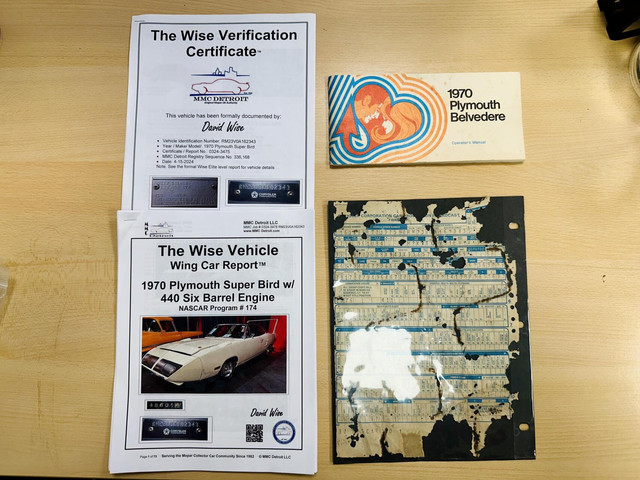
Depending on the brand and model, documentation may include:
- build sheet
- window sticker
- dealer invoice
- factory order documents
- Protect-O-Plate
- Marti Report
- Galves, Galen Govier or brand-specific reports
- previous titles
- old registrations
- restoration invoices
- photographs before and during restoration
- inspection reports
Documents do not automatically make a car correct, but they help support the story. A car with strong documentation is usually easier to understand and easier to trust than a car where everything depends on verbal claims.
Especially with high-value American muscle cars, documentation can be just as important as the car itself.
Professional inspections
If you are buying a serious collector car, it can make sense to involve a marque expert or professional inspector.
Names such as Jerry MacNeish, Galen Govier and Marti Auto Works are well known in the American collector car world. Depending on the brand, model and documentation available, specialists can often give a much stronger opinion about whether a car is correct.
But even then, classic car provenance is not always an exact science.
An expert can inspect, decode, compare, evaluate and give an informed opinion. That is valuable. But no honest expert can change the fact that these cars are often more than 50 years old. Parts may have been changed. Paperwork may be missing. Factory records may be incomplete. Human errors may have happened at the factory.
That is why the best approach is not blind trust. It is careful evaluation.
How PTTM Cars describes matching numbers
At PTTM Cars, we do our best to describe every car as accurately as possible.
When we say a car is matching numbers, we mean that the numbers we can read at the generally accepted locations match the identity of the car, based on the information available to us at that time.
If we believe a car has its original engine, we may state that. If we believe the engine and transmission both match, we may state that. If the car is date-correct, period-correct or equipped with a replacement engine, we try to describe that as clearly as possible.
But we also believe in being realistic.
No classic car dealer can honestly guarantee every detail of a 50-year-old car as if it rolled off the assembly line yesterday. Even with experience, documentation and careful inspection, there is always a degree of interpretation.
If we have facts or a strong indication that a drivetrain is not original, we will not present it as matching numbers. If there is uncertainty, we prefer to be careful with the wording.
That is the only honest way to deal with classic cars.
What buyers should look for
If you are looking at a classic American car and matching numbers matters to you, do not rely on one photo or one sentence in an advertisement.
Look at the complete story.
- Does the VIN match the title and registration?
- Do the body numbers support the VIN?
- Does the trim tag or fender tag make sense?
- Does the engine stamp match the VIN or partial VIN?
- Does the transmission stamp match?
- Are the casting dates realistic?
- Are the assembly dates before the car’s build date?
- Is there a build sheet or window sticker?
- Does the car’s specification match the documentation?
- Does the condition of the car match the story?
- Has the car been restored, and if so, by whom?
- Are there signs of re-stamping, tag swapping or incorrect parts?
One small inconsistency does not always mean the car is wrong. But it does mean you should ask more questions.
Does matching numbers always matter?
No.
It depends on what you want from the car.
If you are buying a rare investment-grade muscle car, matching numbers can be very important. If you are buying a driver, restomod or weekend cruiser, it may matter much less.
Some buyers want the most original car possible. Others prefer upgraded brakes, better suspension, modern air conditioning, fuel injection or a stronger engine. Neither buyer is wrong. They are simply buying for different reasons.
A matching numbers car is not automatically the best car for every person. It is usually the best car for a buyer who values originality, documentation and long-term collector appeal.
A non-matching car can still be more fun, more usable and better suited for real driving.
Final thoughts
Matching numbers is important, but it should be understood properly.
It is not just a marketing phrase. It is not always a black-and-white guarantee. And it is not the only thing that makes a classic American car valuable.
The best cars have a story that makes sense. The VIN, body, drivetrain, dates, documents and condition all support each other. When that happens, confidence goes up. And in the collector car world, confidence matters.
At PTTM Cars, we love original cars. We also love honest cars. Whether a car is matching numbers, date-correct, restored, modified or built to drive, the most important thing is that it is represented correctly.
Because when you buy a classic American muscle car, you are not just buying horsepower.
You are buying history.
Stop dreaming, start living.